

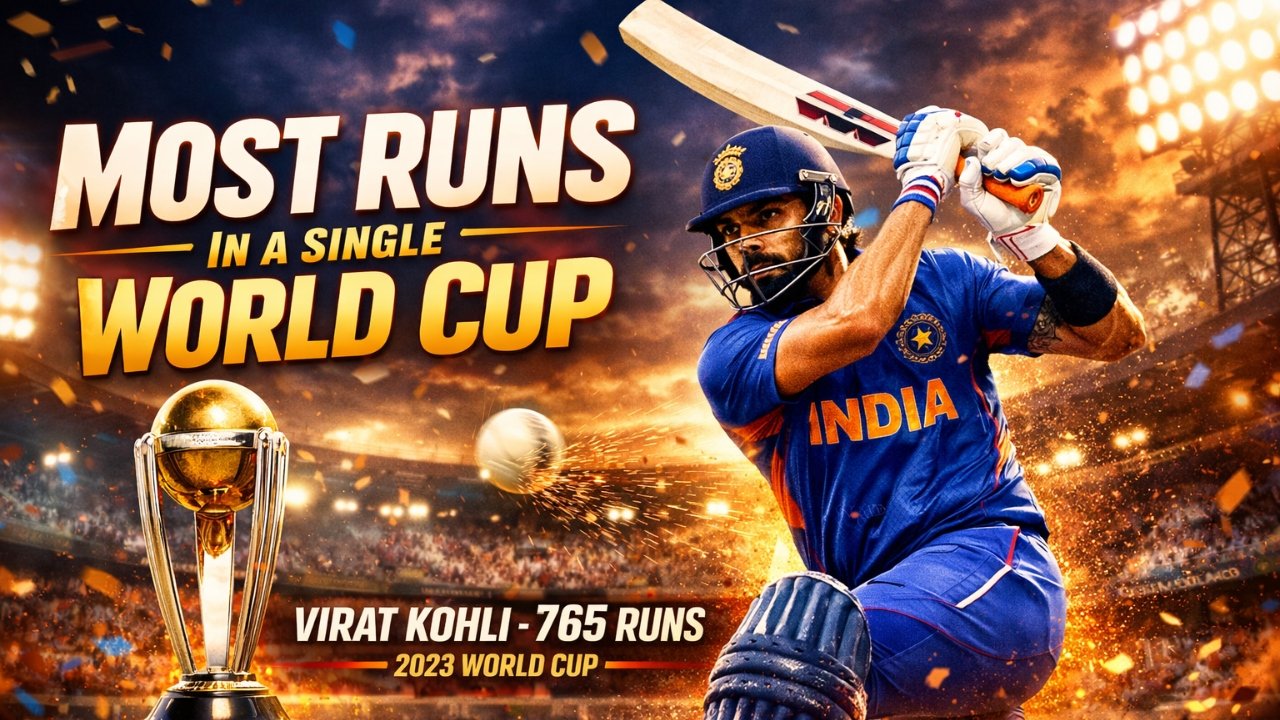
World Cups are there to be won, but for any batsman scoring big in them is one of the most cherished experiences. In a tournament that gathers the cream of cricketers across the globe, to emerge with the most runs in one single edition of the World Cup is an affirmation of skill, consistency, and nothing more than mental strength. In this piece, we take a look at the history, records, memorable innings and relevance of most runs in a single Cricket World Cup across formats – from men’s ODI (50-over) World Cup to women’s tournament. We will also shine a light on some inspiring stories that make this record one of the most celebrated in cricket.
Most Runs in a Single World Cup – What Is It?
In cricket, “most runs in a World Cup” stands for the most number of runs accumulated by a batter during all matches of that edition. These runs are scored in all matches played during the tournament, which include matches in the group stage and knockout rounds.
This statistic reflects:
- Durability and consistency over multiple matches
- How do they shape up to varying bowling and pitches
- Importance of match – especially big runs come in high-pressure games
- Physical and mental endurance of a long tournament
- Onthe men’s or women’s side, this is a record for performing in the clutch.
Men’s ODI World Cup All-Time Record
In the Meta of the ICC Men’s Cricket World Cup (50-over), there is one player who reigns supreme as far as most runs scored in a single edition are concerned:
Record pages can boost engagement by including QR code integration that links readers directly to video highlights and related stats
Virat Kohli – 765 Runs (2023)
- Player: Virat Kohli (India)
- Runs: 765
- Matches: 11
- Tournament: ICC Men’s Cricket World Cup
- Average: 95.62
- Key Contributions: Several centuries and fifties, with big knocks in crunch games.
At the 2023 World Cup, which was heavily based in India, Virat Kohli registered one of the greatest batting performances at a World Cup. His 765 runs eclipsed a record standing for 20 years. His efforts were gritty and stylish, he stood firm in an innings or went on the attack to give India a toe-hold.
Sachin Tendulkar – 673 runs (2003)
Prior to Kohli, the record belonged to one of the best batters in history:
- Player: Sachin Tendulkar (India)
- Runs: 673
- Matches: 11
- Tournament: ICC Men’s Cricket World Cup 2003
- Highlights: Vintage innings against quality teams in trying conditions.
He was the very symbol of consistency and class for guiding India to final at the 2003 World Cup. His mark would stand for over two decades.
Matthew Hayden – 659 runs (2007)
- Player: Matthew Hayden (Australia)
- Runs: 659
- Matches: 10
- Tournament: ICC Men’s Cricket World Cup 2007
- Style: Front-footed stroke play at rapid scoring rates.
Power and precision were his hallmarks as the Australian opener. At the World Cup in 2007, his power-hitting made bowlers tremble all over the world.
Topscorer Probabilities for 2026 T20 World Cup
As the 2026 T20 World Cup nears, there are plenty of big hitters. Abhishek Sharma is the favourite with the top betting sites, whilst the 2023 top scorer, Quinton de Kock of South Africa, will be in the mix too.
Abhishek Sharma (13% chance to be top scorer)
Travis Head (10% chance)
Suryakumar Yadav (10% chance)
Quinton de Kock (8% chance)
Jos Buttler (7% chance)
Other Top Performances (Men’s ODI World Cup)
Here’s a glance at the batting greatness in World Cups, not including the top three:
- Rohit Sharma (India) – 648 runs in 2019
- David Warner (Australia) - 647 runs in 2019
- Shakib Al Hasan (Bangladesh) – 606 runs (2019)
- Quinton de Kock (South Africa) – 594 runs in 2023
- Kane Williamson (New Zealand) - 578 runs in 2019
- Joe Root (England) - 556 runs in 2019
The following players displayed an incredible level of consistency over their seasons as they often would be the solidifying force in innings and successful at getting the job done when it mattered most.
Women’s Cricket World Cup: How the Top Teams Fared
The Women’s Cricket World Cup also boasts of its own list of magnificent records:
Laura Wolvaardt – 571 runs (2025 Women’s World Cup)
- Player: Laura Wolvaardt (South Africa)
- Runs: 571
- Innings: 9
- Tournament: ICC Women’s Cricket World Cup
- Best moments: Two centuries in knockout matches, which included the semi-final and final.
Wolvaardt had an outstanding tournament, especially since her team was never among the favorites. Her will to go big against the best of bowling showed skill and a steely nerve.
The previous record-holder was Australia’s Alyssa Healy (509 runs), highlighting the role played by individual brilliance in helping define the history of women’s cricket.
Why This Record Matters
1) Benchmark of Consistency
To score the most runs in a multi-week competition speaks to more than just talent, it also speaks to form across different conditions and pressures.
2) Pressure and Adaptability
There’s a lot of pressure that comes along with World Cup matches. Batsmen have to adjust to the nature of pitches, conditions and high-pressure matches. Consistently Dominating in such events is an elite Skill.
3) Inspiration for Future Generations
You inspire young cricketers around the world with records like this. ‘The example of players like Kohli, Tendulkar or Wolvaardt shining on the big stage does inspire, you know.
4) Contribution to Team Success
Generally, the teams with top run-scorers win the tournament. These hitters almost always provide their teams a strong chance of winning.
Memorable Performances and Impact
Here, let’s reminisce about some memorable innings of these record-breaking seasons:
1) Virat Kohli (2023)
Kohli hit three hundreds and six half centuries. He was so consistent that he would score in every game and set the tone for India during the tournament.
2) Sachin Tendulkar (2003)
Amongst the great match-winning records in a World Cup that Tendulkar had, his outings against strong oppositions too featured many sizzling innings. His aggregate set the stage for India’s journey to the final.
3) Matthew Hayden (2007)
Hayden’s hard-hitting style gives Australia their aggressive head start and can help define the tempo of an innings.
4) Laura Wolvaardt (2025)
The regularity of Wolvaardt’s run accumulation in the ICCW tournament across a variety of match contexts showcased her star qualities and did wonders for South African women’s cricket.
Evolution of Batting in World Cups
Cricket batting tips over the years: Here’s how cricket batting has changed over the years
- 1975-90: Classical technique guys; scoring was slow and steady
- 1990s and after: Quick run-getters.
- 2000s: Fitness and technology improved, and aggressive play became more prevalent.
- 2010s-2020s: Modern era batsmen such as Kohli and Warner complemented technique with fitness which enabled aggressive scoring through the innings.
The shift of formats, nature of pitches and practice has also provided new idols for run-scorers to follow. Still, to average high across so many matches in a World Cup is very rare and precious.
Conclusion
The most runs by a team in any one World Cup is still one of the most thrilling and loved feats in cricket. From Virat Kohli’s majestic tally of 765 runs in 2023 to Laura Wolvaardt’s heroics at the Women’s World Cup in 2025, these are feats that epitomise what it takes to rise above the rest and stand out as one of the best ever.
These records are not just numbers – they narrate stories of grit, pressure handling and peak performance at cricket’s biggest stage in the world. Whether you’re a professional or an amateur, success at the highest level is something to admire and the following will encourage any budding cricketer.
Faqs about Most Runs in a Single World Cup
Q-1) What is the record for most runs scored by a player in a single Cricket World Cup?
Virat Kohli is the leading run-scorer with 765 runs in ICC Men’s Cricket World Cup 2023.
Q-2) Who was the player who had held the record before Virat Kohli?
The record was previously held by Sachin Tendulkar with 673 runs at the 2003 World Cup.
Q-3) What is a good run score at the World Cup?
A tally of 500 or more runs in a World Cup is generally considered exceptional.
Q-4) Are knockouts included in this record?
Yes, all three runs, such as group stage semi and final matches,s are added for the total.
Q-5) Which player has the highest runs in a Women’s Cricket World Cup?
The women’s record is 571 runs in a single World Cup by Laura Wolvaardt.
Q-6) What makes this phenomenon so unique in cricket?
It symbolizes effort, stamina, and operating at high-performance levels.
Also Read:
- Who is the Prince of Cricket
- Virat Kohli Water Price ₹600 to ₹4000
- Ishan Kishan IPL 2025-26 Price
- Tilak Varma Jersey Number
- List of Yashasvi Jaiswal Centuries in All Formats
- IPL Winners List All Seasons